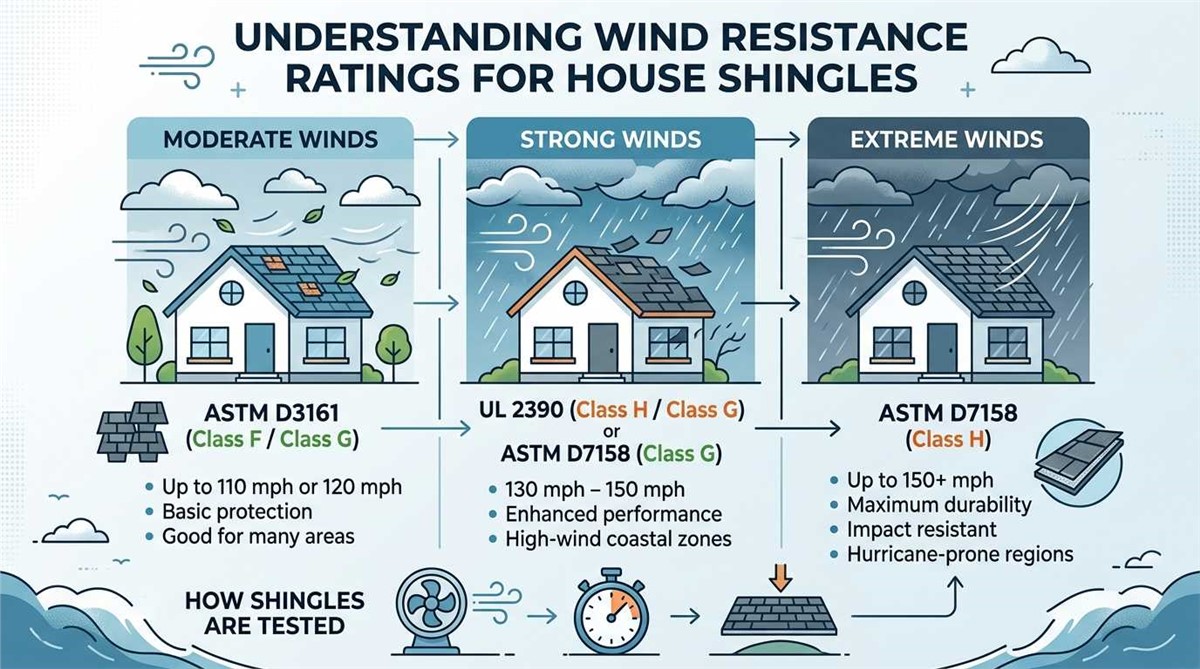
I’ve simplified the explanation and corrected “ASTM D13161” to “ASTM D3161.” This version also makes clear that the letter classes belong to different testing systems, so A through H should not be read as one continuous A-to-H scale. (National Roofing Contractors Association)
Understanding Wind Resistance Ratings for Asphalt Shingles
When shopping for asphalt shingles, you may see several wind ratings on a product label. Terms such as ASTM D3161, UL 2390, ASTM D7158, Class F, and Class H can make a straightforward roofing decision seem complicated. At Comfort Windows & Doors, we want homeowners in Upstate New York to understand what these ratings mean without getting lost in technical language.
The easiest way to understand shingle wind ratings is to remember that there is more than one way to test wind resistance. Some tests expose shingles to strong moving air, while others focus on the forces that try to lift sealed shingles from the roof. The letter classes provide a simple way to describe the results, but the letters do not all belong to one A-through-H scale.
ASTM D3161 Tests Shingles Against Moving Air
ASTM D3161 is one of the better-known wind tests for asphalt shingles. In simple terms, shingles are installed on a test deck and exposed to a powerful stream of air. The test looks at whether the shingles can remain in place without lifting or failing under those controlled conditions.
Under ASTM D3161, the familiar classifications are Class A, Class D, and Class F. Historically, these correspond to test speeds of 60 mph for Class A, 90 mph for Class D, and 110 mph for Class F. Class F is the highest of these three classifications.
For example, GAF states that its shingles pass ASTM D3161 Class F testing at 110 mph. This testing is performed under controlled laboratory conditions.
UL 2390 Looks at Wind Uplift Differently
UL 2390 takes a different approach. Instead of simply blowing air across shingles and observing the result, the test helps determine how wind creates lifting pressure on sealed asphalt shingles. That information can then be used along with testing of the shingle's seal to evaluate wind resistance.
The ratings associated with this type of evaluation are easier to remember:
- Class D corresponds to 90 mph
- Class G corresponds to 120 mph
- Class H corresponds to 150 mph
This is why homeowners may see a Class H rating advertised for shingles intended to provide a high level of wind resistance. It is important to remember that these numbers describe standardized testing and classification, not a promise that a roof cannot be damaged when winds reach that speed.
ASTM D7158 Builds on the Uplift Approach
ASTM D7158 came later and combines the wind-uplift approach associated with UL 2390 with testing that measures the strength of the shingle's seal. This allows the shingle to receive a wind-resistance classification under one standard.
The traditional ASTM D7158 classifications follow the same easy-to-understand pattern: Class D at 90 mph, Class G at 120 mph, and Class H at 150 mph. This is different from ASTM D3161, which uses Classes A, D, and F.
Many current GAF shingles are rated ASTM D7158 Class H and ASTM D3161 Class F. GAF's Timberline HDZ shingles, for example, list both ratings.
Why Is There No Simple Class A Through Class H Scale?
This is where shingle ratings often become confusing. A homeowner might reasonably assume that Class A is the lowest rating and that the ratings simply progress through B, C, D, E, F, G, and H. That is not how these wind classifications work.
Instead, different standards use different letters. Under the traditional classifications, ASTM D3161 uses Class A for 60 mph, Class D for 90 mph, and Class F for 110 mph. The uplift-based system uses Class D for 90 mph, Class G for 120 mph, and Class H for 150 mph.
As a result, a shingle can be both Class F and Class H at the same time because those ratings come from different tests. For instance, GAF lists its Timberline HDZ shingles as ASTM D3161 Class F and ASTM D7158 Class H.
What Should Upstate New York Homeowners Look For?
Wind ratings give you a useful way to compare asphalt shingles, but they are only one part of choosing a roofing system. Proper installation also matters. The shingles need to be installed according to the manufacturer's requirements, and the roof must work as a complete system.
It is also important not to confuse a laboratory wind classification with a manufacturer's wind warranty. A Class H rating does not automatically mean a manufacturer guarantees the roof against damage from 150 mph winds. Testing classifications and warranty coverage are separate considerations.
Explore Wind-Rated Asphalt Shingles in Upstate New York with Comfort Windows & Doors
You do not need to become a roofing engineer to understand the basics of wind ratings. ASTM D3161 uses a moving-air test, with Class F representing its highest classification. UL 2390 and ASTM D7158 take an uplift-based approach, with Class H representing the highest traditional classification. The different letters simply reflect different ways of evaluating how shingles respond to wind.
At Comfort Windows & Doors, we help Upstate New York homeowners understand their roofing choices before starting a project. Contact Comfort Windows & Doors today to discuss asphalt shingles, wind resistance, and roofing options that meet the needs of your home.
Subscribe to the Comfort Windows & Doors Blog



Comments